








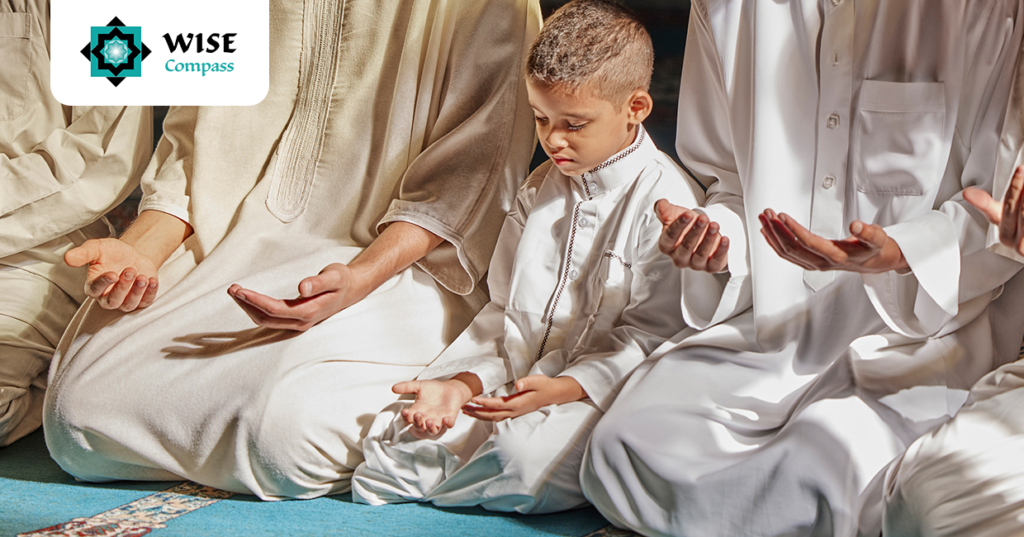
Taraweeh prayer (also spelled Tarawih) is one of the most cherished nightly prayers during Ramadan, a special time when Muslims stand together to listen to and reflect on the words of the noble Quran being recited in congregation. This guide explains what Taraweeh is, how to pray it step-by-step, and how families and beginners can embrace this beloved Sunnah together with confidence and ease.
Whether you are attending the Masjid or praying at home, this guide will help your family understand and embrace Taraweeh with confidence.
Taraweeh Salah is offered during the month of Ramadan only and is prayed after the Isha Salah (Evening prayer). The first Taraweeh Salah is offered on the night before the first fast of Ramadan begins.
The total number of Taraweeh prayers is 20 Rakats (Units of prayer), and they are prayed in sequences of 2 Rakats at a time.
The prayer is usually performed in congregation, though it may also be prayed individually.
The procedure for the prayer is as follows:
The Imam leads the 4 Rakats Fard (Obligatory) prayer for Isha Salah in congregation.
The congregation pray the 2 Rakats Sunnah and the 2 Rakats Nafal (Optional) for Isha.
After this, Taraweeh Salah begins.
The Imam leads 2 Rakats at a time and usually will recite the entire noble Quran, spread out over the entire month.
After completing 20 Rakats, the Imam leads the congregation in the 3 Rakats Witr (Necessary) of Isha, and then the prayers are completed.
Many Muslims wonder what Dua to recite during Taraweeh prayer and after Taraweeh is complete. For a complete guide on the most powerful supplications from the Sunnah, including Tasbeeh for Taraweeh and specific Duas to recite at each stage of the night, read our detailed article: Dua After Taraweeh – The Quiet Power of the Supplication Between the Rakats.
One of the most beautiful and beneficial traditions of Taraweeh Salah is listening to the noble Quran being recited night after night during the month of Ramadan. For generations, Muslim communities around the world have gathered in Masjids to stand together and hear the words of Allah Almighty unfold gradually across the month.
It is considered an important Sunnah for the entire noble Quran to be recited during Taraweeh Salah. Many Islamic scholars from the different Islamic Schools of Law (especially the Hanafi School) encourage this practice, even when people begin to feel tired, as a way of preserving this long-standing and meaningful tradition.
At the same time, Islam is a religion of balance and understanding. It is not obligatory for the entire noble Quran to be completed during Taraweeh. In some parts of the world, especially when Ramadan falls in the summer and nights are very short, communities may shorten the prayers to make them more manageable.
Alongside the congregation, every person is encouraged to try to complete recitation of the noble Quran individually during the month of Ramadan, even if it is done a little at a time. Whether it is a few verses a day or a longer portion, each effort is a good deed upholds the spirit of the month.
During Taraweeh Salah, it is permissible to repeat the same Quranic Chapters (Surahs) and Verses (Ayahs). This can be especially helpful for those who are still learning or building confidence in their recitation.
However, it is not preferred to recite the same Surah in both cycles of a single 2 Rakat prayer. For example, it is not preferred to recite Surah Al Ikhlaas (Chapter 112) in both the first and second cycle of the prayer.
A simple and beneficial approach is to recite one Surah in the first cycle and a different Surah in the second cycle, and to repeat this pattern throughout the 20 Rakats. This helps build familiarity with more of the noble Quran and supports memorisation over time.
Above all, the goal is not to rush, but to grow. Each verse recited is an opportunity to strengthen one’s connection with the words of Allah Almighty.
Taraweeh Salah holds a special place in the month of Ramadan and is specific to this blessed time of year. However, the door to night prayer remains open throughout the year.
Outside of Ramadan, Muslims are encouraged to offer Tahajjud Salah (Voluntary night prayer) and may also pray 20 Rakats of Qiyaam Al Layl (Standing prayer of the night). While these prayers closely resemble Taraweeh in their form and spirit, they are specific voluntary night prayers that are different to Taraweeh prayer.
Whether during Ramadan or beyond it, standing in prayer at night is a quiet and personal way to reflect, seek closeness to Allah Almighty, and carry the calm and purpose of worship into everyday life.
Taraweeh Salah, in all its forms, is a gentle invitation to return to the noble Quran and to create moments of peace, reflection, and spiritual growth, both as individuals and as families. Every sincere act of worship, no matter how small, carries deep meaning and lasting reward.
Not everyone is able to fast during Ramadan. Illness, old age, and other valid reasons can make fasting difficult or impossible. Even in these circumstances, Taraweeh Salah remains a confirmed Sunnah and a meaningful way to take part in the blessings of the month.
For those who cannot fast, standing in prayer at night can become a source of comfort and connection. It offers a way to still feel part of the spiritual atmosphere of Ramadan, to listen to the noble Quran, and to share in the sense of togetherness that fills homes and Masjids during this time.
In this way, Taraweeh becomes a reminder that worship is not limited to one form alone. Each person’s situation is different, and every sincere effort to turn toward Allah Almighty, whether through fasting, prayer, recitation, or quiet remembrance, carries its own value and reward.
Taraweeh Salah is prayed in paced, steady sets of two units, building toward a total of 20 Rakats across the night. This way of praying has been agreed upon by all four Schools of Islamic Law (Hanafi, Shafi, Maliki and Hanbali) and reflects a long and carefully preserved tradition within the Muslim community. Understanding how this practice developed helps bring a deeper appreciation for what happens in Masjids and homes throughout the nights of Ramadan.
During the lifetime of holy Prophet Muhammad ﷺ, he would lead the Taraweeh Salah himself. The early Muslim community would gather behind him, drawn by both his recitation and his presence. One well-known narration in Sahih Bukhari describes a moment that reveals the deep care of holy Prophet Muhammad ﷺ for his followers and their ease in worship.
It is recorded in Sahih Bukhari, Hadith 1129 that:
‘Holy Prophet ﷺ took a room made of date palm leaves mats in the Masjid. Allah Almighty’s Messenger ﷺ prayed in it for a few nights until the people gathered (to pray behind him). Then, on the 4th night the people did not hear his voice and they thought he had slept, so some of them started humming in order that he might come out. Prophet Muhammad ﷺ then said: “You continued doing what I saw you doing until I was afraid that this (Taraweeh prayer) might be made obligatory upon you.”’
This moment shows a beautiful balance between encouragement and compassion. Holy Prophet Muhammad ﷺ loved to see people eager to pray, yet he was also mindful of not placing a burden on the community. For this reason, he ﷺ did not always lead the full 20 Rakats in congregation every night. He did not want anyone to feel that Taraweeh was an obligation rather than a voluntary and beloved act of worship.
As the Muslim community grew after his time, the practice of Taraweeh continued to develop. During the Caliphate of Murshid Khalifa Umar ibn Khattab (RA), a thoughtful step was taken to bring unity and structure to the night prayers in Ramadan. This is reported in Sahih Bukhari by one of the Blessed Prophetic Companions, who said:
“I went out with (Murshid Khalifa) Umar ibn Khattab (RA) in Ramadan, to the Masjid and the people there were spread out in groups. Some men were praying by themselves, whilst others were praying in small groups. (Murshid) Umar (RA) said: ‘By Allah Almighty! It would be better in my opinion if these people gathered behind one reciter.’ So, he gathered them behind (Murshid) Ubayy ibn Ka’ab (RA). Then I went out with him another night and the people were praying behind their noble Quran reciter. (Murshid) Umar (RA) said: ‘How excellent this new way is!’”
From this point onward, Taraweeh became a shared congregational experience, led by an Imam (Congregational prayer leader), and offered as 20 Rakats. This practice has continued across generations, connecting worshippers today with those who stood in prayer centuries ago.
Because of this long and unified tradition, it is not preferred for a person, whether praying at home or in the Masjid to limit Taraweeh to only 8 Rakats. While any prayer is valuable and rewarded, offering fewer than 20 Rakats would not be considered the completion of the Sunnah practice of Taraweeh.
Seen in this light, the 20 Rakats of Taraweeh are more than a number. They represent a living link to holy Prophet Muhammad ﷺ, his Blessed Companions, and the Blessed generations of scholars and pious Muslims that followed.
Each set of 2 Rakats becomes part of a wider story of care, community, and continuity, reminding worshippers that their nightly prayers are woven into a tradition that has been cherished and protected throughout the history of Islam.