








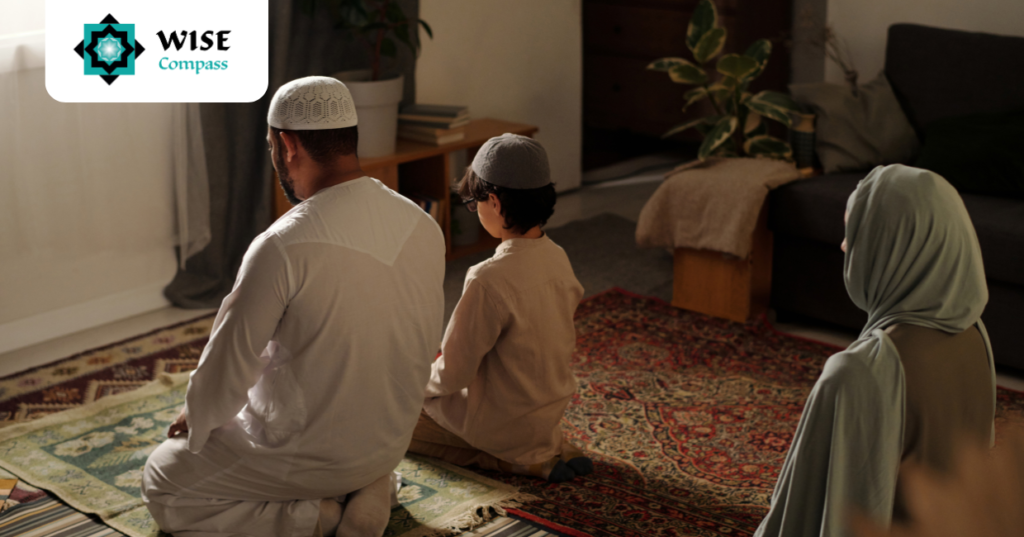
Many Muslim parents want to teach their children Duas (supplications) that they will use throughout life. One of the most important Duas that every praying person needs to know is Dua Qunoot (also referred to as ‘Dua Qunut’ or ‘Dua-e-Qunoot’). This is a special Dua recited in Witr prayer, which is the prayer offered in 3 units. This Dua asks Allah Almighty for guidance, protection, forgiveness, and blessings.
Because different mosques and Islamic schools of thought may use different Qunoot Duas, children may hear more than one version. This Wise Compass guide includes the two most common versions, so kids can learn with confidence, and parents can teach what matches their local practice.
Dua Qunoot is a supplication that is recited while standing in Salah (prescribed daily prayer). The word ‘Qunoot’ itself refers to a special supplication made during prayer, asking Allah Almighty for help and protection.
There are a few times Dua-e-Qunoot is recited depending on local practice:
Most parents who teach kids usually refer to the well-known Dua Qunoot in Witr.
This depends on how your family or religious community prays, but here are the most common situations:
Because practices can differ between different schools of thought, it is best to follow your local mosque’s method if you are learning it for Salah.
This is the simplest way to decide:
Your child is likely hearing the Dua-e-Qunoot commonly taught for daily Witr (often after Isha):
Arabic:
اللَّهُمَّ إِنَّا نَسْتَعِينُكَ وَنَسْتَغْفِرُكَ
Transliteration:
Allahumma inna nastaeenuka wa nastaghfiruk
Meaning (Simple English)
O Allah Almighty, we seek Your help and we ask Your forgiveness.
Your child is likely hearing this well-known Qunoot:
Arabic:
اللَّهُمَّ اهْدِنِي فِيمَنْ هَدَيْتَ
Transliteration:
Allahumma ihdinee feeman hadayt
Meaning (Simple English)
O Allah Almighty, guide me among those whom You have guided.
Teach the version your child hears at your mosque first. Later, introduce the second version, so they will recognise it too.
This version is commonly memorised by children because it is frequently taught for praying the daily Witr Rakats in Salah in many communities.
Arabic:
اللَّهُمَّ إِنَّا نَسْتَعِينُكَ وَنَسْتَغْفِرُكَ
وَنُؤْمِنُ بِكَ وَنَتَوَكَّلُ عَلَيْكَ
وَنُثْنِي عَلَيْكَ الْخَيْرَ وَنَشْكُرُكَ وَلَا نَكْفُرُك
وَنَخْلَعُ وَنَتْرُكُ مَنْ يَفْجُرُكَ
اللَّهُمَّ إِيَّاكَ نَعْبُدُ
وَلَكَ نُصَلِّي وَنَسْجُدُ
وَإِلَيْكَ نَسْعَى وَنَحْفِدُ
وَنَرْجُو رَحْمَتَكَ وَنَخْشَى عَذَابَكَ
إِنَّ عَذَابَكَ بِالْكُفَّارِ مُلْحِقٌ
Transliteration:
Allahumma inna nastaeenuka wa nastaghfiruka
Wa nu’minu bika wa natawakkalu ‘alayka
Wa nuthnee ‘alaykal-khayr, wa nashkuruka wa la nakfuruk
Wa nakhla‘u wa natruku man yafjuruka
Allahumma iyyaka na‘budu
Wa laka nusallee wa nasjudu
Wa ilayka nas‘a wa nahfid
Wa narju rahmataka wa nakhsha ‘adhabak
Inna ‘adhabaka bil-kuffari mulhiq
O Allah Almighty, we ask You for help and forgiveness
And we believe in You and rely on You
We praise You with goodness and thank You; and we do not deny You
We forsake and abandon whoever disobeys You.
O Allah Almighty, You alone we worship
And to You we pray and prostrate ourselves
And to You we hasten and strive
And we hope for Your mercy and fear Your punishment. Indeed
Your punishment will surely befall the disbelievers.
This version is widely recited in many communities and is loved for its simple yet powerful meaning: guidance, wellbeing, and protection.
Arabic:
اللَّهُمَّ اهْدِنِي فِيمَنْ هَدَيْتَ
وَعَافِنِي فِيمَنْ عَافَيْتَ
وَتَوَلَّنِي فِيمَنْ تَوَلَّيْتَ
وَبَارِكْ لِي فِيمَا أَعْطَيْتَ
وَقِنِي شَرَّ مَا قَضَيْتَ
فَإِنَّكَ تَقْضِي وَلَا يُقْضَى عَلَيْكَ
وَإِنَّهُ لَا يَذِلُّ مَنْ وَالَيْتَ
وَلَا يَعِزُّ مَنْ عَادَيْتَ
تَبَارَكْتَ رَبَّنَا وَتَعَالَيْتَ
Transliteration:
Allahumma ihdinee feeman hadayt
Wa ‘afinee feeman ‘afayt
Wa tawallanee feeman tawallayt
Wa barik lee feema a‘ṭayt
Wa qinee sharra ma qaḍayt
Fa’innaka taqdee wa la yuqda ‘alayk
Wa innahu la yadhillu man walayt
Wa la ya‘izzu man ‘adayt
Tabarakta rabbana wa ta‘alayt
O Allah Almighty, guide me among those You have guided
And grant me wellbeing among those You have granted wellbeing
And befriend me among those You have befriended
And bless me in what You have given me
And protect me from harm (resulting from anything that You have decreed)
You decide, and no one can decide against You
And indeed, none is humiliated whom You befriend
And none are honoured whom You oppose
Blessed are You, our Lord, and Exalted are You
For kids and beginners, keep it simple:
Even adults forget sometimes. Allah Almighty rewards your effort.
Here’s how to explain it to children:
Dua Qunoot is a special Dua where we ask Allah Almighty to:
You can tell kids:
It’s like saying: ‘Ya Allah Almighty, please look after me in every way.’
Pick the version your child hears most often:
Starter line (Version 1):
اللَّهُمَّ إِنَّا نَسْتَعِينُكَ وَنَسْتَغْفِرُكَ
Allahumma inna nasta’eenuka wa nastaghfiruk
O Allah Almighty, we ask You for help and forgiveness…
Starter line (Version 2):
اللَّهُمَّ اهْدِنِي فِيمَنْ هَدَيْتَ
Allahumma ihdinee feeman hadayt
O Allah Almighty, guide me…
Kids memorise faster when they understand what they’re saying.
Two lines per week is better than rushing.
Practice after Isha or before bedtime, short and consistent.
Both of these popular versions of Dua Qunoot are well-known and widely recited. The best plan for Muslim families is simple: