







The ‘Hijra’ or ‘Hijrah’ (Migration) of holy Prophet Muhammad ﷺ and the Muslim community from Makkah to Madinah in 622 CE is one of the most powerful lessons of courage in all of Islamic history. You can use this story to teach children what true courage is; it is not the absence of fear rather it is:
By connecting the events of the Hijrah to your child’s own experiences of change, fear, and new beginnings, you give them a living example of bravery rooted in faith rather than force. This article gives you Five Practical Steps to bring that teaching to life.
Every child will face some moment that asks them to be brave. Starting a new school. Standing up for what is right. Telling the truth when it is easier not to. Walking away from a group that is behaving wrongly. Losing something familiar and having to begin again.
These moments can feel very large indeed for children and young people. As parents, we want to give our children tools and life lessons that are lasting and will help them with these challenges they will inevitably face. As well as words of guidance and motivational support, we are blessed to have the ideal role model for them to look up to and emulate throughout life. A role model who faced something far greater than any challenge we may ever encounter, and who chose courage every time.
In 622 CE, holy Prophet Muhammad ﷺ and his blessed companions were compelled to leave Makkah, the city beloved to them for housing the blessed Ka’bah and as their place of birth, because the persecution from the Quraysh (the dominant tribe of Makkah) had become life-threatening. They escaped out of the city and walked into the unknown. They were hunted. They had nothing to rely on except their faith in Allah Almighty. Yet they arrived in a sanctuary. They built a new community. They changed the world.
And their journey of bravery and overcoming adversity by relying on Allah Almighty, is the story that can give your child a compass for every frightening moment they will ever face.
Before children can draw courage from a story, they must feel it. So before you explain the significance of the Hijrah, tell it as a story with detail, with feeling, and with age-appropriate language.
For younger children (ages 4-7 years), you can explain it in this way:
‘Holy Prophet Muhammad ﷺ had to leave his home because bad people wanted to hurt him because he was a Muslim. He trusted Allah Almighty completely. He walked through the desert at night with his best friend to go to a safe place, and Allah Almighty kept them safe the whole way.’
For older children (ages 8-12 years), you can expand with more detail:
‘Holy Prophet Muhammad ﷺ knew that staying in Makkah had become too dangerous for him and the early Muslims. The Quraysh had made a plan to kill him. So, by the command and permission of Allah Almighty, he and his closest companion, Khalifa Abu Al Bakr Siddiq (RA), left Makkah under cover of darkness. They hid in the Cave of Thawr for three days while Makkan search parties hunted for them. The enemies of Islam came right to the mouth of the cave, and did not find them because Allah Almighty protected His two blessed servants. When the way was clear, they completed the journey to Madinah, where the Muslim community was at last free to live, worship, and grow as servants of Allah Almighty.’
The point is not to rush to the lesson. Let the story land first.
One of the most useful things you can do is help your child understand that courage is not one single thing. The Hijrah is filled with different expressions of it, and your child will easily recognise themselves in at least one of them if you help make the link for them.
Holy Prophet Muhammad ﷺ left the city he loved most in the world. He left his home, his community, and the blessed Ka’bah.
Helping children connect this to their own experiences – moving house, changing schools, losing a friendship – makes the lesson personal and powerful.
Khalifa Abu Bakr Al Siddiq (RA) could have chosen silence and personal safety over being a loyal friend and companion. Instead, he stood openly beside holy Prophet Muhammad ﷺ and shared every risk in the journey. This is the courage of loyalty, integrity and standing up for the truth.
When the Quraysh forces reached the cave entrance, there was no escape route left for the blessed servants of Allah Almighty. What remained was their Tawakkul (Complete reliance on Allah Almighty). This is one of the most important lessons of the entire Hijrah for children: that faith comes before all else, and that courage to embrace your faith is blessed with acceptance by Allah Almighty.
Arriving in an unfamiliar city, with nothing but what they carried, the early Muslims built a life and a community that was completely new. The courage to ‘start over’ after significant change – whether it is a great upheaval or just a disruption that is tough to deal with – is a real and significant form of bravery that children can relate to.
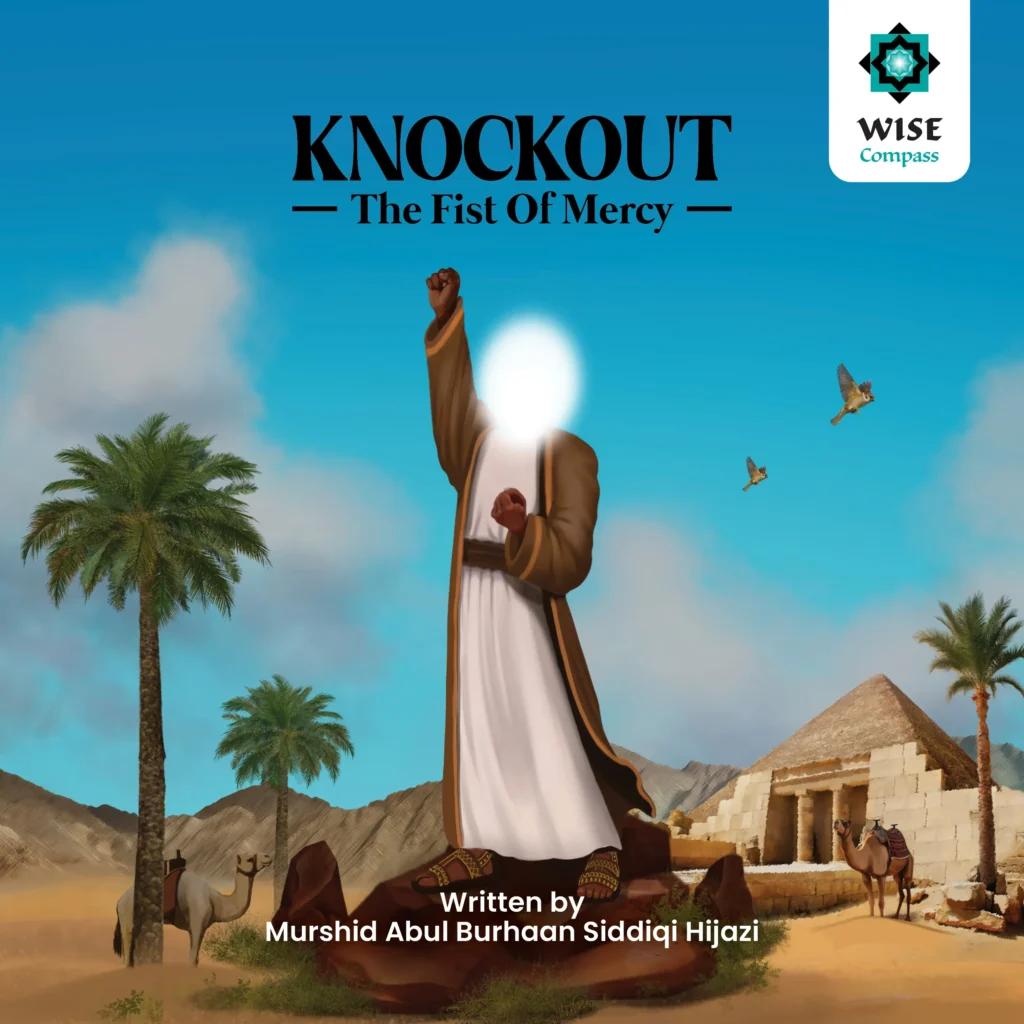
This is a wonderful moment to share the Wise Compass book Knockout – The Fist of Mercy with your child. It tells the story of how Prophet Musa (AS) faced a violent confrontation in the streets of Egypt and had to make a courageous decision in a single moment – a decision that changed the course of his life. It shows children that standing up for what is right, even when it costs you everything, is the true definition of nobility and the mark of a Muslim who is not willing to compromise their beliefs. Read this book alongside telling your child the story of Hijrah to show them that courage runs through the lives of all of Allah Almighty’s Prophets (AS).
Children need to understand that courage in Islam is not bravado or recklessness. It is anchored in deep faith in Allah Almighty. Two sources help communicate this beautifully.
Allah Almighty Himself addresses this exact moment of the Hijrah in the noble Quran. Describing the scene in the Cave of Thawr, where holy Prophet Muhammad ﷺ comforted his companion with the most famous words of reassurance in Islamic history, Allah Almighty states in the noble Quran at Surah Al Tawbah (9), Verse 40:
إِذْ يَقُولُ لِصَاحِبِهِۦ لَا تَحْزَنْ إِنَّ ٱللَّهَ مَعَنَا
Idh yaqoolu lisaahibihii laa tahzan innallaaha ma’anaa
When he said to his companion, ‘Do not grieve. Indeed, Allah Almighty is with us.’
Help your child understand the weight of this verse. In one of the most frightening moments a person can imagine, hiding in a cave under the nose of enemies hunting him just outside, holy Prophet Muhammad ﷺ did not panic. He remained confident of Allah Almighty’s help and offered reassurance to someone else. That is what faith-rooted courage looks like in practice.
In his own words, holy Prophet Muhammad ﷺ has also given definitive guidance to Muslims about what true strength is. It is reported in Sahih Bukhari, Hadith 6114, that holy Prophet Muhammad ﷺ said:
The strong is not the one who overcomes the people by his strength, but the strong is the one who controls himself while in anger.
This describes what true courage looks like in character: it is not physical strength or the ability to confront or overpower others, but in the ability to control oneself in moments of difficulty.
For older children (ages 8-12 years), you can ask:
‘What do you think is harder: punching someone who is mean to you, or choosing not to and walking away? Which takes more strength?’
This question alone can open up a rich conversation.
At Wise Compass, we know that children do not always absorb a lesson the first time they hear it; they absorb it best when they feel it personally and repeatedly, across different stories and contexts. Two Wise Compass books that are a particularly powerful companion to the Hijrah lesson include An Oasis in the Desert and Honour Amongst Thieves.
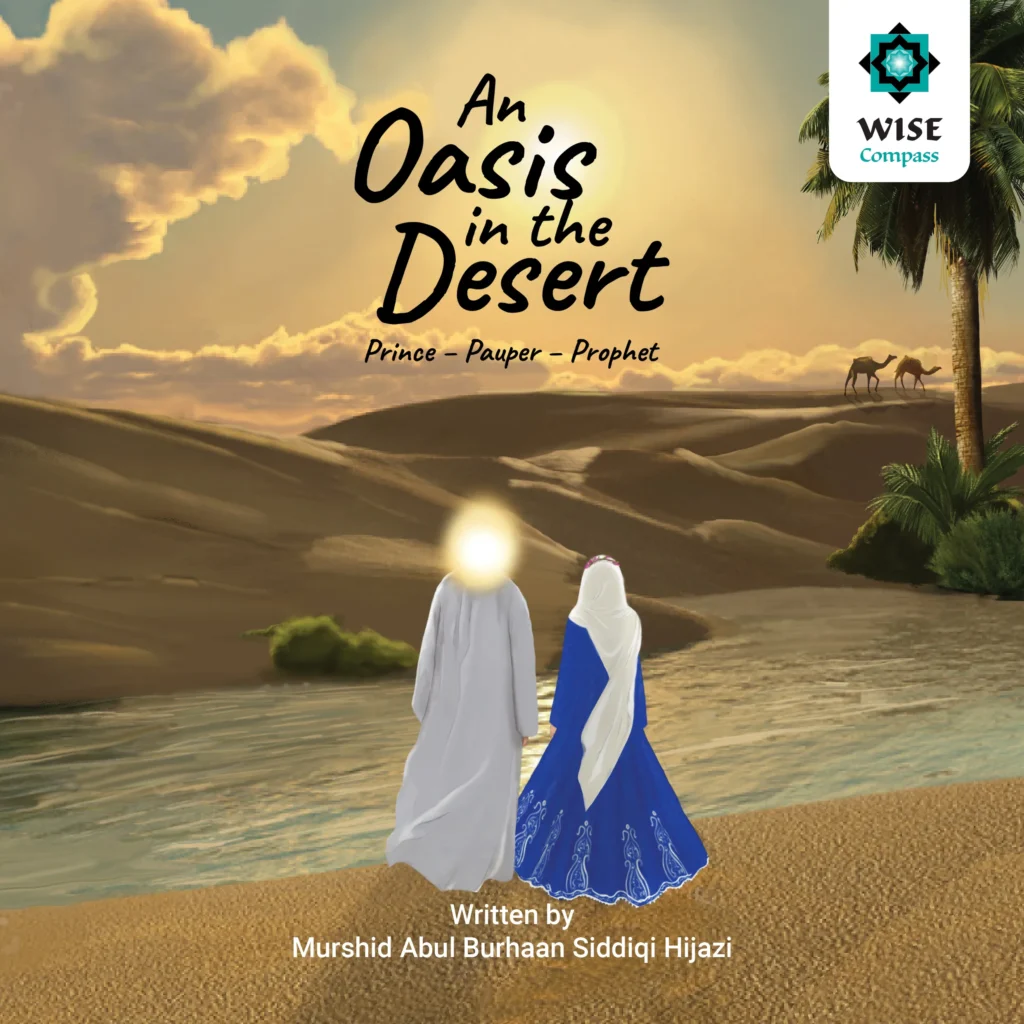
An Oasis in the Desert tells the story of a pious prince who willingly leaves behind a life of wealth and comfort to live honestly among simpler, more virtuous people. Like holy Prophet Muhammad ﷺ leaving Makkah, this prince discovers that leaving behind the familiar but corrupt is not a loss; it is the beginning of something truer and better. The courage to walk away from ease when Allah Almighty calls you to something greater is at the heart of this story.
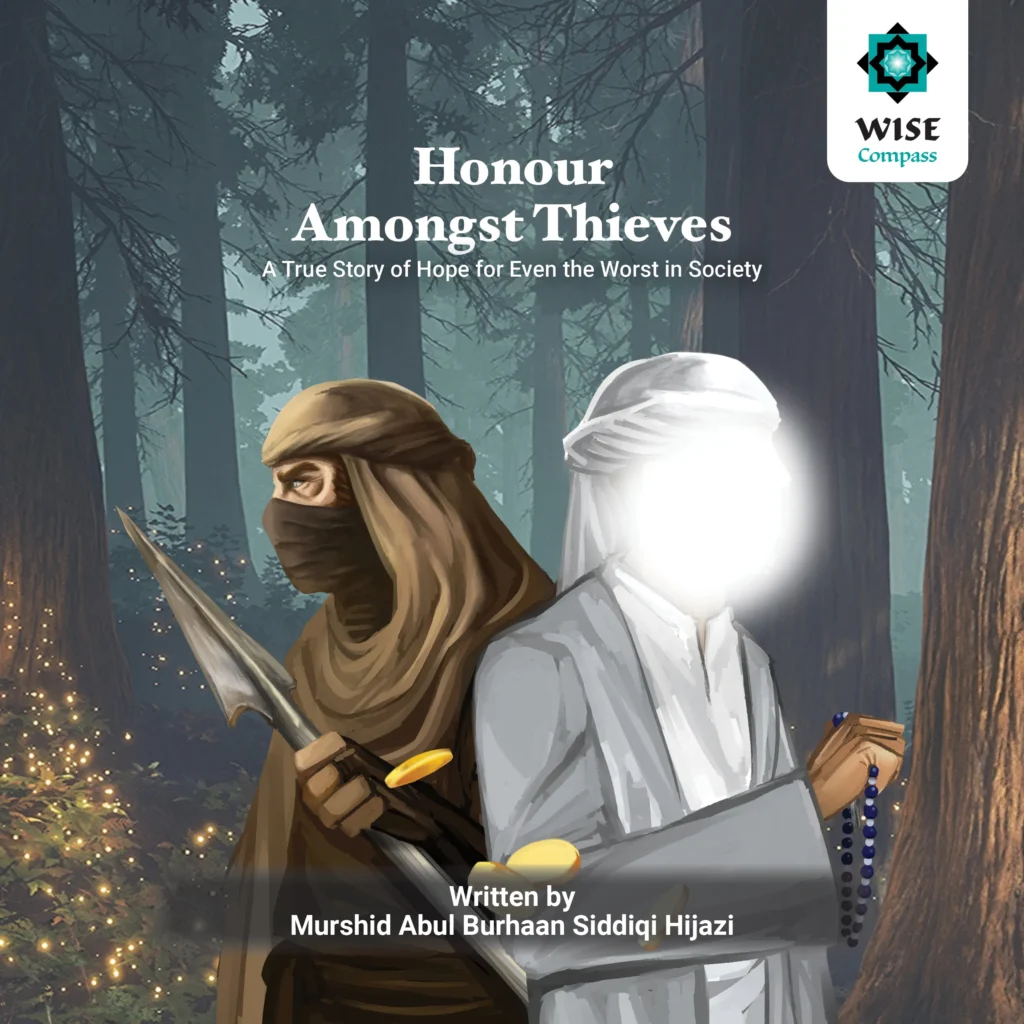
Honour Amongst Thieves is a true account of a pious young man who keeps his word and tells the truth even when he is surrounded by sixty dangerous thieves. His strength of character and honesty has the power to change even the worst of men. This mirrors the Hijrah in a vital way: holy Prophet Muhammad ﷺ was outnumbered by enemies but he did not compromise his faith and integrity. His good character preceded him everywhere, including to Madinah, where the people already loved and trusted him before he arrived. And even among his enemies he was known and trusted as Al Ameen (The Trustworthy One). In both of these examples, children can see that honesty and courage together are unstoppable.
The Hijrah should not remain a story from history. It should become a living conversation in your home. Here are some specific and practical ways to make this possible for you:
Create a ‘Hijrah moment’ Question
When your child faces something frightening or difficult, ask them: ‘What do you think holy Prophet Muhammad ﷺ felt during the difficulty of the Hijrah? What did he do in that tough situation? What positive thing can you do in your tough situation that follows his example?’ This is not a pressure technique; it is a life tool, a way of giving them a real role model to turn to and emulate in their times of difficulty.
Talk About the Cave Moment Specifically
Discuss the story of Hijrah and personalise it for your child. Ask your child: ‘If you were hiding in a cave and the enemy came right to the door, what would you feel? How do you think Khalifa Abu Al Bakr (RA) felt? What do you think made holy Prophet Muhammad ﷺ able to say “Do not grieve” at that moment?’ These questions build genuine theological reflection in children, not just surface-level knowledge.
Acknowledge That Courage Can Look Like Fear
Children can unconsciously internalise stereotypes that do not serve them well. They might mistakenly think fear and courage are unrelated and that feelings of worry or fear are something to be ashamed of and therefore deal with them unhealthily. Tell your child directly: ‘Being brave does not mean you are not frightened or that you do not feel the struggle of your situation. It means you choose the right thing even when you feel that way. Holy Prophet Muhammad ﷺ was the best of all humanity and he too felt strong emotions when facing difficulties. One of the things that made him extraordinary and that is a great example to us, is that his faith in Allah Almighty was always greater than any feeling.’
Mark the Islamic New Year as a Courage Checkpoint.
The Hijrah is the event from which the Islamic calendar itself begins. Every year, on the 1st of Muharram, the first month of the Islamic calendar, revisit this story with your child and ask them: ‘What is one brave thing you want to do this year?’ Making it a personal tradition and collective family activity makes it beloved to your child and gives it permanence and longevity in their life.
The Hijrah was not simply a journey across a desert. It was the first step that transformed a persecuted minority group into a thriving majority civilisation. It led to the production of the first Islamic State, the first Muslim community built on justice and brotherhood, and is the blueprint for individuals and communities alike of how to begin again with nothing but faith and positive character.
When you teach your child this story with care and depth, you are not just teaching them a historical event. You are giving them a way of thinking about every difficult moment they will ever face. You are telling them that leaving something behind can be the beginning of something greater when the intention and outlook is to please Allah Almighty. You are teaching them that fear and faith can exist in the same heart, at the same time. That Allah Almighty is always with those who trust in Him. As Allah Almighty states in the noble Quran at Surah Al Sharh (94), Verses 5-6:
فَإِنَّ مَعَ ٱلْعُسْرِ يُسْرًا
إِنَّ مَعَ ٱلْعُسْرِ يُسْرًا
5. Fa-inna ma’al ‘usri yusraa
6. Inna ma’al ‘usri yusraa
5. For indeed, with hardship will come ease
6. Indeed, with hardship will come ease.
That is the promise of Allah Almighty. And the Hijrah is its living proof.
You can begin introducing the story of the Hijrah from as young as 4 or 5 years old, keeping the focus on simple, concrete emotions: holy Prophet Muhammad ﷺ had to leave his home, he was brave; and Allah Almighty kept him safe. As children grow, you can add more layers: the political context, the Companions involved, and the miracles of the cave, deepening the lesson at each stage of your child’s mental and emotional development. The story itself is age-flexible; what changes is the depth of detail you share.
Tell your child that there were people in Makkah who did not want others to follow the truth of Islam. They were afraid of losing their power and position, and so they tried very hard to stop holy Prophet Muhammad ﷺ and the early Muslims from worshipping Allah Almighty freely. Rather than fight back in anger, holy Prophet Muhammad ﷺ chose to move to another city to protect his community and to build something better in a new place. This teaches children that sometimes the bravest thing is not to fight, but to move forward wisely.
The Cave of Thawr is the single most powerful illustration of Tawakkul (Complete reliance on Allah Almighty) in the entire Hijrah story. Holy Prophet Muhammad ﷺ and Khalifa Abu Bakr Al Siddiq (RA) hid there for 3 days whilst enemy search parties came within metres of finding them. Rather than despairing, holy Prophet Muhammad ﷺ told his Companion not to grieve because Allah Almighty was with them. For children, this is a teachable moment: courage does not mean certainty about the outcome. It means certainty about Allah Almighty.
The Hijrah is precisely about leaving the familiar behind and beginning again in an unfamiliar place. Holy Prophet Muhammad ﷺ loved Makkah deeply, yet he was able to go. When children face transitions, you can remind them that even the greatest person who ever lived had to start again in a new place and that Allah Almighty guided him there and blessed him with a community that welcomed him with joy. Transitions are not punishments. Sometimes they are the path to something better.
The Companions of holy Prophet Muhammad ﷺ chose the Hijrah as the starting point of the Islamic calendar because it marked the beginning of the Muslim community as an organised, free, and functioning society. It was the moment the Ummah (Muslim nation and community) truly began to take shape. Teaching children this fact helps them understand that Islam is not just a private belief; it is a way of life built on courage, sacrifice, and community. And the Hijrah was the moment that that community was born.
No, and this is one of the most important things you can teach your child from the Hijrah. Courage is not the absence of fear. Khalifa Abu Bakr Al Siddiq (RA) was anxious for the safety of holy Prophet ﷺ in the cave; but holy Prophet Muhammad ﷺ himself comforted him. What made them courageous was that their trust in Allah Almighty was greater than any worry about the intent of their enemy. True courage, as the Hijrah shows us, is choosing the right action even when every part of you wants to run from it.