











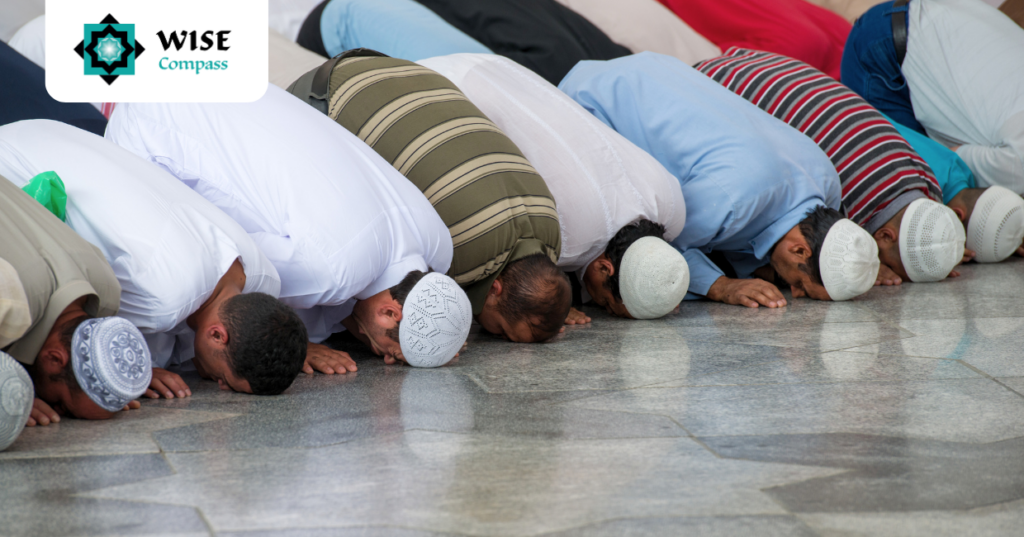
Jummah (Friday congregational prayer) is the special Salah (Prescribed prayers) that Muslims offer on Friday in place of Zuhr (Midday prayer). It is obligatory for every mature, sane Muslim man to attend in congregation at the Masjid (Place of prayer), after listening to the Khutbah (Formal sermon). The word Jummah is linked to the Arabic idea of gathering, which reflects how the community comes together every week. It is reported in Sahih Muslim, Hadith 854, that holy Prophet Muhammad ﷺ called Friday the best day upon which the sun has risen, which is why Jummah carries such great reward.
Jummah is the Friday congregational prayer, also written as Jumma, Jumuah or Jumu’ah, and often called Jummah Salah or Jummah Namaz (the Urdu and Persian word for Salah). The name is connected to the Arabic idea of gathering, because on this day believers come together at the same time, in the same place, to worship Allah Almighty as one community. Friday itself is known as Yawm Al Jumu’ah (The Day of Gathering).
For parents, the questions often start at home. If your child has ever asked why the family stops everything to pray, the story Like Mother, Like Daughter follows young Aaliyah as she asks her mother exactly that, and makes a gentle first introduction to Salah.

The Friday prayer has a very special rank in Islam. Holy Prophet Muhammad ﷺ taught that Friday is greater in the sight of Allah Almighty than even the two days of Eid, which shows how highly this day is valued. It is reported in Sunan Ibn Majah, Hadith 1084, that holy Prophet Muhammad ﷺ said:
إِنَّ يَوْمَ الْجُمُعَةِ سَيِّدُ الْأَيَّامِ، وَأَعْظَمُهَا عِنْدَ اللَّهِ، وَهُوَ أَعْظَمُ عِنْدَ اللَّهِ مِنْ يَوْمِ الْأَضْحَى وَيَوْمِ الْفِطْرِ
‘Indeed, the day of Jumu‘ah (Friday) is the best of days and the greatest of them according to Allah Almighty. It is greater according to Allah Almighty than the Day of (Eid) Al Adha and the Day (Eid) of Al Fitr.’
It is an obligatory prayer for every able-bodied, adult male to attend and pray in congregation and is offered instead of Zuhr Prayer, at its appointed time at the post-mid-day. Jummah Salah has been prescribed by Allah Almighty on the best of days, Friday.
Friday is called ‘Sayyid Al Ayaam’ meaning the ‘Leader of All Days’ because of many blessed events that have occurred in human history and many that will come to pass by the blessing of Allah Almighty on Fridays. It is reported in Sunan Ibn Majah, Hadith 1084 that holy Prophet Muhammad ﷺ said:
إِنَّ يَوْمَ الْجُمُعَةِ سَيِّدُ الْأَيَّامِ، وَأَعْظَمُهَا عِنْدَ اللَّهِ
‘Friday is the best of days…’
It is reported in Sahih Muslim, Hadith 854 that holy Prophet Muhammad ﷺ said:
خَيْرُ يَوْمٍ طَلَعَتْ عَلَيْهِ الشَّمْسُ يَوْمُ الْجُمُعَةِ
‘The best day upon which the sun has risen is Friday…’
These are not casual remarks but in fact part of formal teachings about the significance of Friday. The following are all events which took place or will take place on a Friday:
PAST
PRESENT AND CONTINUOUS
FUTURE
Allah Almighty has made prayer easy for people without reducing their reward, so the Jummah prayer is obligatory upon every mature, sane Muslim man, apart from the following exceptions:
Females are not obligated to attend Jummah prayer in order to reduce any burden or hardship on them. However, females are welcome to join this blessed prayer if they can, and it will be accepted from them in place of the Zuhr prayer.
The obligation itself comes directly from the noble Quran. Allah Almighty states in the noble Quran at Surah Al Jumuah (62), Verse 9:
يَا أَيُّهَا الَّذِينَ آمَنُوا إِذَا نُودِي لِلصَّلَاةِ مِن يَوْمِ الْجُمُعَةِ فَاسْعَوْا إِلَى ذِكْرِ اللَّهِ وَذَرُوا الْبَيْعَ ذَلِكُمْ خَيْرٌ لَّكُمْ إِن كُنتُمْ تَعْلَمُونَ
O those of you who are believers, when you are summoned for prayer (by the calling of Adhaan) on the day of Friday; then hasten towards the remembrance of Allah (Almighty); and leave your businesses (for those moments); for this is more advantageous for you, if only you could understand.
Allah Almighty orders the believers to leave their business and general work and to attend the Friday prayers. This confirms that it is obligatory upon each individual male to partake in the Jummah prayers, even if they are busy in worldly matters. It directly shows that the Friday prayer is better for the believers than any other ‘profitable’ business they are engaged in.
Holy Prophet Muhammad ﷺ gave specific instructions and recommendations for those going to perform Jummah, and promised forgiveness for those who follow them.
It is reported in Sahih Bukhari, Hadith 883 that holy Prophet Muhammad ﷺ said:
لاَ يَغْتَسِلُ رَجُلٌ يَوْمَ الْجُمُعَةِ، وَيَتَطَهَّرُ مَا اسْتَطَاعَ مِنْ طُهْرٍ، وَيَدَّهِنُ مِنْ دُهْنِهِ، أَوْ يَمَسُّ مِنْ طِيبِ بَيْتِهِ ثُمَّ يَخْرُجُ، فَلاَ يُفَرِّقُ بَيْنَ اثْنَيْنِ، ثُمَّ يُصَلِّي مَا كُتِبَ لَهُ، ثُمَّ يُنْصِتُ إِذَا تَكَلَّمَ الإِمَامُ، إِلاَّ غُفِرَ لَهُ مَا بَيْنَهُ وَبَيْنَ الْجُمُعَةِ الأُخْرَى
‘Whoever performs the ritual bath on Friday, purifies himself as much as he can, then uses his oil or perfumes himself with the scent of his house, then proceeds (for the Jummah prayer) and does not separate two persons sitting together (in the Masjid), then prays what has been prescribed for him and then remains silent while the Imam is delivering the Khutbah, his sins between the present and the last Friday would be forgiven.’
Holy Prophet Muhammad ﷺ outlines some of the etiquettes in preparation of the Friday prayer and confirms that whoever performs them, their sins of the past week shall be forgiven.
Further guidance about the virtue and etiquettes of the Friday prayer are also explained in another Hadith. It is reported in Jami Tirmidhi, Hadith 496 that holy Prophet Muhammad ﷺ said:
مَنِ اغْتَسَلَ يَوْمَ الْجُمُعَةِ وَغَسَّلَ وَبَكَّرَ وَابْتَكَرَ وَدَنَا وَاسْتَمَعَ وَأَنْصَتَ كَانَ لَهُ بِكُلِّ خَطْوَةٍ يَخْطُوهَا أَجْرُ سَنَةٍ صِيَامُهَا وَقِيَامُهَا
‘Whoever performs Ghusul on Friday, and bathes completely, and goes early, arriving early, gets close and listens and is silent, there will be for him in every step he takes the reward of a year of fasting and standing (in prayer).’
In addition to the above, holy Prophet Muhammad ﷺ also warned against missing Jummah prayers, due to its significance and importance. It is reported in Sahih Muslim, Hadith 865 that holy Prophet Muhammad ﷺ said:
لَيَنْتَهِيَنَّ أَقْوَامٌ عَنْ وَدْعِهِمُ الْجُمُعَاتِ أَوْ لَيَخْتِمَنَّ اللَّهُ عَلَى قُلُوبِهِمْ ثُمَّ لَيَكُونُنَّ مِنَ الْغَافِلِينَ
‘People must cease to neglect the Friday prayer or Allah Almighty will seal their hearts and then they will be among the negligent.’
Missing Jummah prayers deliberately is a sinful action as this prayer is obligatory for Muslims. It is especially detrimental for anyone who abandons, avoids, or misses Jummah Salah without good reason as they are missing out on its innumerable blessings.
If a person is at work or school and cannot get time off to attend the Jummah prayers, then it is advisable to arrange an onsite Jummah prayer for all the Muslims on site. If this cannot be arranged, then there is no specific compensatory prayer or action to make up for missing Jummah, except that it remains obligatory for the person to offer the Zuhr prayer as normal.
Jummah has certain acts that are not needed for any other prayer, namely the two Adhaans (Calls to Prayer), the Khutbah, and the Fard (Obligatory) Rakats (Units of prayer). Here is the full sequence in simple steps.
On Friday morning, take a Ghusul, clean yourself well, wear clean clothes and apply perfume, as mentioned in the Hadith above. Make Wudhu (Ritual ablution) if needed before leaving for the Masjid.
Leave in good time so that you can sit close to the Imam (Congregational prayer leader) and avoid stepping over or separating people who are already seated. Going early is where the great reward of every step is gained.
When the first Adhaan is called, pray 4 Sunnah Mua’akkadah (Regularly performed, emphasised Sunnah) Rakats. Make the Niyyah (Intention) in your heart for the prayer you are offering.
The second Adhaan is called when the Imam is ready to begin the sermons. It reminds the congregation that the Jummah prayer is about to commence.
The first sermon is optional. It is a public sermon for general guidance, given in the language of the local community, and does not have to be delivered by the Imam. If the Imam gives it, he will sit before rising to give the Arabic Khutbah.
The Khutbah is the obligatory formal sermon, and it must be recited in Arabic, like all acts of worship. Remain silent and attentive while the Imam delivers it, as the Hadith above confirms.
Stand in rows behind the Imam and pray the 2 Fard Rakats of Jummah in congregation. These two Rakats take the place of the four Fard Rakats of Zuhr, and cannot be prayed alone.
After the Fard prayer, offer 4 Sunnah Mua’akkadah Rakats, followed by 2 more Sunnah Mua’akkadah Rakats.
Complete the sequence with 2 Nafal (Optional) Rakats, then make Dua (Supplication), remembering that Friday contains an hour in which supplications are accepted.
The complete Jummah sequence has 14 Rakats: 4 Sunnah Mua’akkadah before the Khutbah, 2 Fard, 4 Sunnah Mua’akkadah, 2 Sunnah Mua’akkadah, and 2 Nafal. Only the 2 Fard Rakats are obligatory.
At the time of holy Prophet Muhammad ﷺ there was only one Adhaan at the time of Jummah. As the Muslim community grew, Murshid Khalifa Uthman (RA) added a second Adhaan at the beginning of the prayer time, so that people had time to finish their trade and get ready. This accepted practice has been preserved as a reminder that Jummah is about to commence.
Some of the Blessed Prophetic Companions (RA) narrated that they saw holy Prophet Muhammad ﷺ leaning on a staff or bow while reciting the Jummah Khutbah. Prophets of Allah Almighty (AS) also used to carry a staff, as they were the shepherds of their people. This Sunnah has been preserved as a sign of authority that befits the leader of the congregation, which is why the Imam holds a staff while delivering the Arabic Khutbah.
Jummah must be prayed in congregation and cannot be prayed alone. During the week, people offer their prayers at home or wherever they are, but on Jummah the whole community comes together at the same time. It is a blessed way to spend time together, share news and strengthen bonds, and we should be grateful for the opportunity and make every effort to attend.
Children often notice Friday before they understand it, from dads and older brothers leaving for the Masjid to the family dressing a little differently. Sharing the meaning of Jummah early helps them see Friday as a joyful, special day rather than a rule. For younger children (4-7 years), you can explain it in this way:
‘Jummah is our special Friday prayer, when everyone comes together to talk to Allah Almighty.’
Short, gentle bedtime stories for kids about Salah are a natural way to keep the conversation going at home. For children aged 7+ who are ready to ask deeper questions, the books for young readers in our Young Explorers range can help them connect Salah with faith and character.
Jummah is the Friday congregational prayer in Islam. It is offered in place of Zuhr, at its appointed time just after mid-day, and includes two Adhaans, a Khutbah and 2 Fard Rakats prayed in congregation at the Masjid.
Jummah, also written Jumma, Jumuah or Jumu’ah, is connected to the Arabic idea of gathering. It reflects the fact that Muslims come together as one community every Friday to worship Allah Almighty.
The complete sequence is 14 Rakats: 4 Sunnah Mua’akkadah, 2 Fard, 4 Sunnah Mua’akkadah, 2 Sunnah Mua’akkadah and 2 Nafal. Only the 2 Fard Rakats are obligatory.
No. Females are not obligated to attend Jummah, in order to reduce any burden or hardship on them. They are welcome to join if they can, and their Jummah will be accepted in place of Zuhr.
No. Jummah must be prayed in congregation and cannot be prayed alone. If someone cannot attend, they offer the Zuhr prayer as normal.
Jummah is offered in place of Zuhr on Friday. Unlike Zuhr, it includes the Khutbah and two Adhaans, and its Fard prayer is 2 Rakats prayed in congregation rather than 4.
There is no specific compensatory prayer for a missed Jummah. The person must offer the Zuhr prayer as normal. Missing Jummah deliberately without good reason is sinful, so anyone at work or school should try to arrange an onsite Jummah for all the Muslims there.
Jummah is the weekly gathering that brings the whole community together before Allah Almighty on the best of days. By preparing well, going early, listening to the Khutbah and praying with sincerity, we gain blessings that last until the next Friday. May Allah Almighty make us all among those who value and protect their Jummah.